
Between any two individuals, the human genome differs by around 0.1% — meaning each individual has millions of sites in their genome that collectively make them unique. The impact of genetic variation on human health and disease is complex and immense; in order to accelerate research and advance patient care, it is vital to unlock the potential of the world’s genetic variation data and exchange it reliably across diagnostic labs, electronic health records (EHRs), research institutions, and knowledge-bases. Developed by the GA4GH Genomic Knowledge Standards (GKS) Work Stream, the Variation Representation Specification (VRS) is a computational “language” that enables consistent communication across these systems.
Video credit -
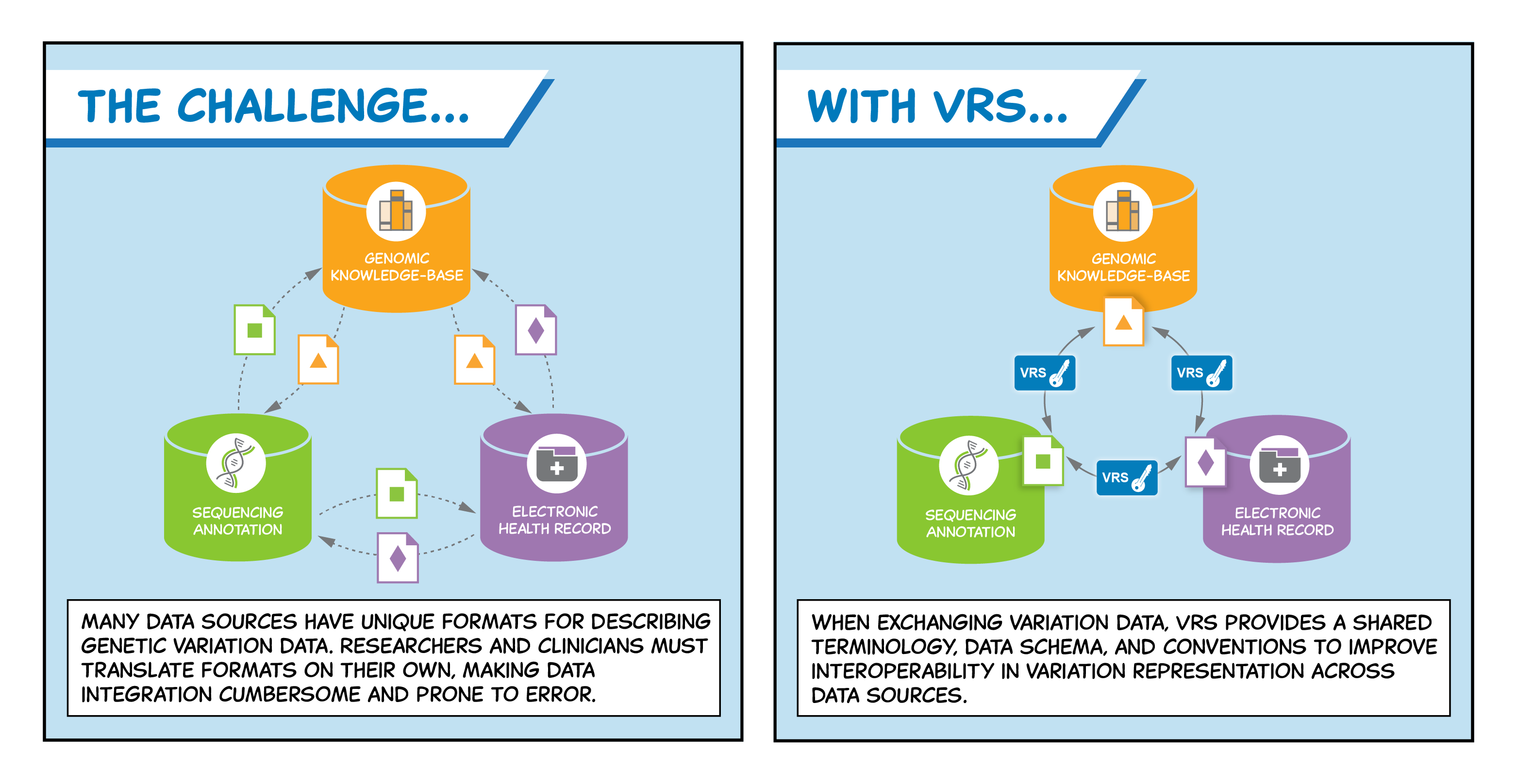
Image summary -
Benefits
- Enables scalable federated computable exchange of genetic variants
- Allows interoperable reuse within other specifications due to its modular design
- Provides a framework for variation in linked data exchange
Target users
Researchers, clinicians, and clinical laboratories
Announcements
| Title | Related Driver Projects and Organisations |
|---|---|
| BRCA Exchange | BRCA Challenge |
| ClinGen Knowledge-base | Clinical Genome Resource (ClinGen) |
| The Exomiser | Monarch Initiative |
| Variant Interpretation for Cancer Consortium (VICC) Meta-Knowledgebase (v1) | Variant Interpretation for Cancer Consortium (VICC) |
Publications
Documents
| Date | Title |
|---|---|
| 16 October 2026 | GKM Meeting Minutes |
| 8 November 2023 | Meeting Minutes: GKS – Structural Variation Special Interest Group |
| 14 September 2023 | Code of Ethics and Community Conduct (CECC) |
| 11 March 2023 | Meeting minutes: GKS — Variation Representation (2023) |
Videos
| Date | Title | |
|---|---|---|
 |
6 January 2025 | GKS Work Stream Open House (January 2025) |
 |
29 June 2022 | VRS tutorials: an introduction to the GA4GH Variation Representation Specification |
 |
7 June 2021 | VRS webinar (Genomics in Health Implementation Forum) |
Contributors
Don't see your name..?
Get in touch- Larry BabbVariation Representation Specification (VRS) LeadBroad Institute of MIT and Harvard, Cambridge, US
- Alex WagnerVariation Representation Specification (VRS) LeadNationwide Children’s Hospital, Columbus, OH, Variant Interpretation for Cancer Consortium (VICC), International
- Steven BrennerUniversity of California, Berkeley, Berkely
- Daniel CameronIllumina, Inc., San Diego
- Bimal ChaudhariNationwide Children’s Hospital, Columbus, OH
- Melissa ClineUniversity of California, Santa Cruz, Santa Cruz
- Raymond DalgleishUniversity of Leicester, Leicester, UK
- Kyle FerriterBroad Institute of MIT and Harvard, Cambridge, US
- Robert FreimuthMayo Clinic, Rochester
- Wesley GoarNationwide Children’s Hospital, Columbus, OH
- Malachi GriffithThe Genome Institute at Washington University, Saint Louis, Variant Interpretation for Cancer Consortium (VICC), International
- Melissa HaendelUNC School of Medicine
- Reece HartMyOme
- Seik-Soon KhorNational Center for Global Health and Medicine
- Melissa KonopkoELIXIR, International
- Kori KuzmaNationwide Children’s Hospital, Columbus, OH
- Jennifer LeeSequencing.com, https://sequencing.com
- Christa Lese MartinGeisinger Health System, Danville
- Xuelu (Jeff) LiuDana-Farber Cancer Institute, Boston
- Anna LuNIH National Cancer Institute (NCI), Bethesda
- Eric MoyerNIH National Center for Biotechnology Information (NCBI)
- Tristan NelsonGeisinger Health System, Danville
- Vivek NuthalapatiEpic Systems
- Andreas PrlićInvitae, Inc., San Francisco
- Heidi RehmMassachusetts General Hospital, Boston, Broad Institute of MIT and Harvard, Cambridge, US
- Kevin RiehleBaylor College of Medicine
- Alan RubinWalter and Eliza Hall Institute of Medical Research, Parkville
- Anastasia SmithNationwide Children’s Hospital, Columbus, OH
- Kathryn StahlNationwide Children’s Hospital, Columbus, OH
- James StevensonNationwide Children’s Hospital, Columbus, OH
- Jing SuWellcome Sanger Institute (WSI), Hinxton, UK
- Mrinal ThomasEpic Systems
- Brian WalshKnight Diagnostic Laboratories, Oregon Health & Science University, Portland
- Ziying YangUniversity of Zurich, Zurich
- Andy YatesEMBL's European Bioinformatics Institute (EBI), Hinxton, UK
- Zhenyu ZhangUniversity of Chicago, Chicago
- Hangjia ZhaoUniversity of Zurich, Zurich
Driver Projects
| Title | Thematic Area |
|---|---|
| BRCA Challenge | Rare Disease Cancer |
| Clinical Genome Resource (ClinGen) | Rare Disease |
| Monarch Initiative | Rare Disease Cancer Complex Traits Basic Biology |
| Variant Interpretation for Cancer Consortium (VICC) | Cancer |