About us
Learn how GA4GH helps expand responsible genomic data use to benefit human health.

Learn how GA4GH helps expand responsible genomic data use to benefit human health.
Our Strategic Road Map defines strategies, standards, and policy frameworks to support responsible global use of genomic and related health data.
Discover how a meeting of 50 leaders in genomics and medicine led to an alliance uniting more than 5,000 individuals and organisations to benefit human health.
GA4GH Inc. is a not-for-profit organisation that supports the global GA4GH community.
The GA4GH Council, consisting of the Executive Committee, Strategic Leadership Committee, and Product Steering Committee, guides our collaborative, globe-spanning alliance.
The Funders Forum brings together organisations that offer both financial support and strategic guidance.
The EDI Advisory Group responds to issues raised in the GA4GH community, finding equitable, inclusive ways to build products that benefit diverse groups.
Distributed across a number of Host Institutions, our staff team supports the mission and operations of GA4GH.
Curious who we are? Meet the people and organisations across six continents who make up GA4GH.
More than 500 organisations connected to genomics — in healthcare, research, patient advocacy, industry, and beyond — have signed onto the mission and vision of GA4GH as Organisational Members.
These core Organisational Members are genomic data initiatives that have committed resources to guide GA4GH work and pilot our products.
This subset of Organisational Members whose networks or infrastructure align with GA4GH priorities has made a long-term commitment to engaging with our community.
Local and national organisations assign experts to spend at least 30% of their time building GA4GH products.
Anyone working in genomics and related fields is invited to participate in our inclusive community by creating and using new products.
Wondering what GA4GH does? Learn how we find and overcome challenges to expanding responsible genomic data use for the benefit of human health.
Study Groups define needs. Participants survey the landscape of the genomics and health community and determine whether GA4GH can help.
Work Streams create products. Community members join together to develop technical standards, policy frameworks, and policy tools that overcome hurdles to international genomic data use.
GIF solves problems. Organisations in the forum pilot GA4GH products in real-world situations. Along the way, they troubleshoot products, suggest updates, and flag additional needs.
GIF Projects are community-led initiatives that put GA4GH products into practice in real-world scenarios.
The GIF AMA programme produces events and resources to address implementation questions and challenges.
NIF finds challenges and opportunities in genomics at a global scale. National programmes meet to share best practices, avoid incompatabilities, and help translate genomics into benefits for human health.
Communities of Interest find challenges and opportunities in areas such as rare disease, cancer, and infectious disease. Participants pinpoint real-world problems that would benefit from broad data use.
The Technical Alignment Subcommittee (TASC) supports harmonisation, interoperability, and technical alignment across GA4GH products.
Find out what’s happening with up to the minute meeting schedules for the GA4GH community.
See all our products — always free and open-source. Do you work on cloud genomics, data discovery, user access, data security or regulatory policy and ethics? Need to represent genomic, phenotypic, or clinical data? We’ve got a solution for you.
All GA4GH standards, frameworks, and tools follow the Product Development and Approval Process before being officially adopted.
Learn how other organisations have implemented GA4GH products to solve real-world problems.
Help us transform the future of genomic data use! See how GA4GH can benefit you — whether you’re using our products, writing our standards, subscribing to a newsletter, or more.
Join our community! Explore opportunities to participate in or lead GA4GH activities.
Help create new global standards and frameworks for responsible genomic data use.
Align your organisation with the GA4GH mission and vision.
Want to advance both your career and responsible genomic data sharing at the same time? See our open leadership opportunities.
Join our international team and help us advance genomic data use for the benefit of human health.
Discover current opportunities to engage with GA4GH. Share feedback on our products, apply for volunteer leadership roles, and contribute your expertise to shape the future of genomic data sharing.
Solve real problems by aligning your organisation with the world’s genomics standards. We offer software dvelopers both customisable and out-of-the-box solutions to help you get started.
Learn more about upcoming GA4GH events. See reports and recordings from our past events.
Speak directly to the global genomics and health community while supporting GA4GH strategy.
Be the first to hear about the latest GA4GH products, upcoming meetings, new initiatives, and more.
Questions? We would love to hear from you.
Read news, stories, and insights from the forefront of genomic and clinical data use.
Publishes regular briefs exploring laws and regulations, including data protection laws, that impact genomic and related health data sharing
Translates findings from studies on public attitudes towards genomic data sharing into short blog posts, with a particular focus on policy implications
Attend an upcoming GA4GH event, or view meeting reports from past events.
See new projects, updates, and calls for support from the Work Streams.
Read academic papers coauthored by GA4GH contributors.
Listen to our podcast OmicsXchange, featuring discussions from leaders in the world of genomics, health, and data sharing.
Check out our videos, then subscribe to our YouTube channel for more content.
View the latest GA4GH updates, Genomics and Health News, Implementation Notes, GDPR Briefs, and more.
7 Apr 2026
The Global Alliance for Genomics and Health (GA4GH) is introducing a new Work Stream focused on developing governance recommendations and data standards to foster responsible integration of artificial intelligence (AI) in genomics and health.
By Jaclyn Estrin, GA4GH Senior Science Writer
Artificial Intelligence (AI) stands to increase the productivity and accessibility of scientific discovery in genomics and health. However, siloed approaches to AI risk creating systems that are fragmented, inaccessible to lower-resourced institutions, and unable to interoperate. To address these risks in the context of human health and medicine, the Global Alliance for Genomics and Health (GA4GH) is launching a new AI Work Stream to bring together world experts and coordinate a standardised approach to integrate AI into genomics in a responsible, interoperable, and equitable manner.
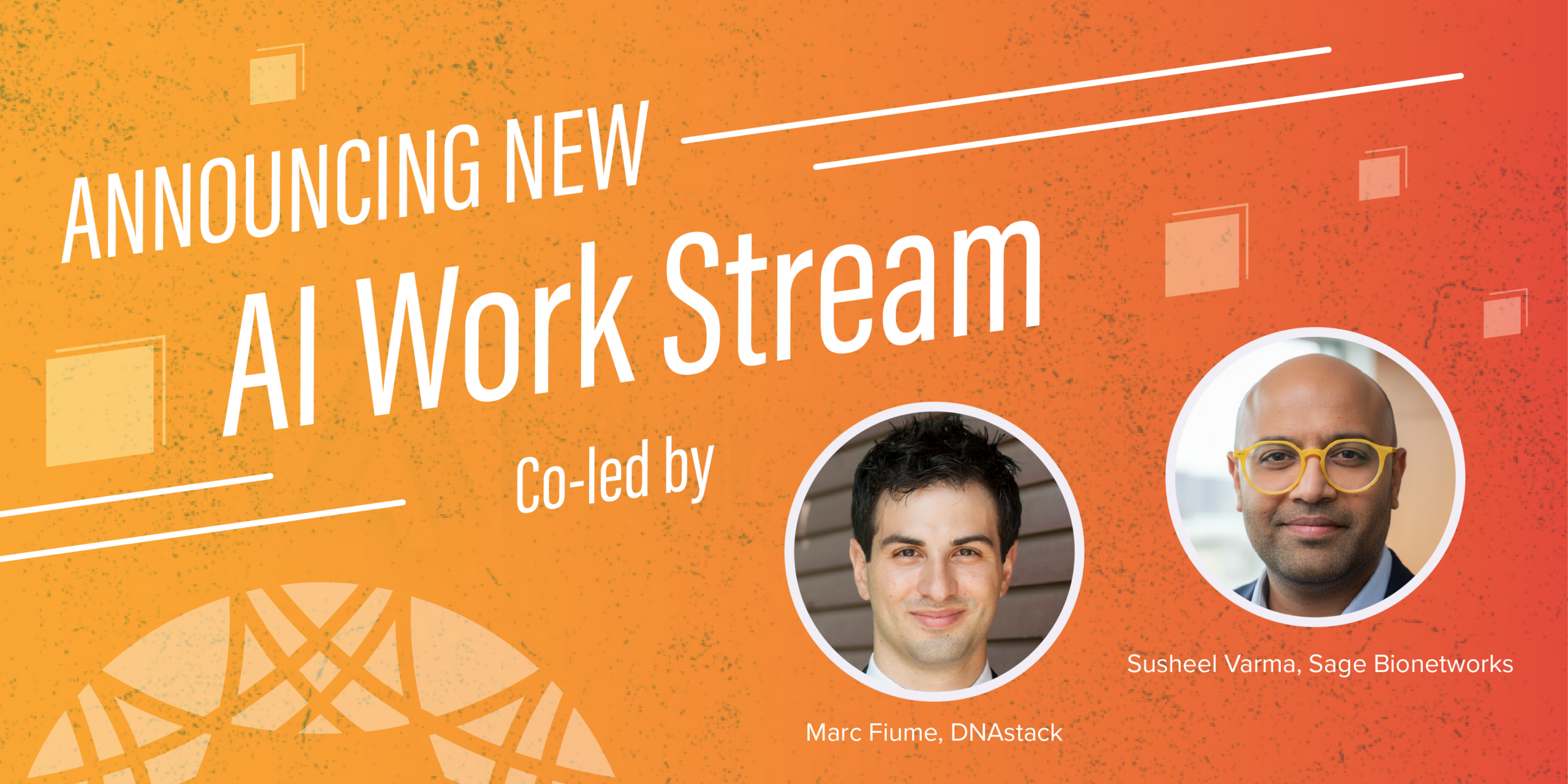
GA4GH Work Streams drive the development of genomics and health data standards, policy frameworks, and implementation resources. For the first time since the Work Stream structure launched in 2017, GA4GH is now introducing a new, foundational Work Stream, joining Regulatory & Ethics (REWS) and Data Security (DSWS) in addressing cross-cutting needs within the global genomics community. The new AI Work Stream will be led by Marc Fiume (Co-Founder and CEO, DNAstack) and Susheel Varma (Chief Data Officer, Sage Bionetworks) to provide technical leadership and guide standards development within this space.
Fiume has contributed to GA4GH for over a decade, serving as a founding Co-Lead of GA4GH’s Discovery Work Stream and launching the Beacon API to develop standards that facilitate genomic data discoverability and sharing. His professional background includes implementing GA4GH standards as part of production systems that power international collaborative research in rare disease, neuroscience, oncology, and infectious disease. Fiume has experience building GA4GH compliant systems that support applications in AI, including model training, federated learning, and agentic science.
Varma has been a longstanding contributor to the Cloud and Discovery Work Streams, focusing on secure data access and analysis. Before joining Sage Bionetworks, he served as the Head of AI and Data Science at the UK Information Commissioner’s Office and was previously Chief Technology Officer at Health Data Research UK, roles centred on building national-scale research infrastructure for ethical sharing of personal health data, as well as regulating how AI systems use sensitive data.
“We have a generational opportunity to understand the complex causes of disease with molecular precision. GA4GH standards are making it possible to make data interoperable across institutions, indications, and borders,” said Fiume. “And with AI, we stand to make scientific discovery exponentially more productive. This Work Stream will help ensure we do this safely, securely, and equitably.”
AI is fundamentally changing how science is being conducted at every stage of the research cycle, from hypothesis generation to analysis and interpretation of results. There is growing interest in the use of AI across the genomics and health ecosystem to understand how the technology can be used to drive efficiencies in scientific research, speed up diagnostic timelines, and advance medical care.
“Genomics only transforms health if the world agrees on how to share, interpret, and govern data,” said Sasha Siegel, Chief Product Officer of GA4GH. “We have been building technical standards and policy frameworks that allow genomic data to move responsibly across institutions and borders. If AI is going to transform genomics in healthcare, it has to scale with integrity, and our role at GA4GH is to make sure that it does.”
The AI Work Stream will develop guidance and health data standards that interoperate across the healthcare ecosystem. This work will be grounded in four key principles:
Varma said, “We are trying to galvanise the community to think through what end-to-end AI-driven science projects look like when built on standards: identifying what is missing, and what complementary capabilities we need to add to augment that standard to be AI-native or AI-compatible.”
The Work Stream is designed to be a collaborative forum, welcoming contributors with diverse expertise, ranging from technical and policy to implementation experience. The leadership team aims to engage in cross-Work-Stream collaboration to develop jointly owned products that address shared problem statements.
Fiume said, “GA4GH brings together world experts who think deeply about how to translate the value of human data into better health outcomes. It is the right community to lead the conversation on responsible AI, and to make sure the standards we develop are practical, useful, and widely adopted.”
As their work commences, the Work Stream will produce deliverables including standards, metadata schemas, provenance requirements, conformance tests, implementation guides, reference implementations, position papers, and white papers. The leads are looking to develop implementation demonstration projects that showcase how AI can be used to advance a specific use case with increased efficiency and productivity, while maintaining security and equity.
AI is a transformative technology that has an immense potential to shape the future of genomics and health, increase productivity, and drive discoveries. Yet, it is crucial to harness and steer the use of AI through a collective, international approach to data governance and standards. Varma said, “The trust infrastructure that governs how data is shared, accessed, and used is what determines whether AI systems are safe and equitable in practice, not just in principle. That is what GA4GH does better than anyone, and it is what this Work Stream will build on to foster safe, responsible, and equitable science at scale.”