About us
Learn how GA4GH helps expand responsible genomic data use to benefit human health.

Learn how GA4GH helps expand responsible genomic data use to benefit human health.
Our Strategic Road Map defines strategies, standards, and policy frameworks to support responsible global use of genomic and related health data.
Discover how a meeting of 50 leaders in genomics and medicine led to an alliance uniting more than 5,000 individuals and organisations to benefit human health.
GA4GH Inc. is a not-for-profit organisation that supports the global GA4GH community.
The GA4GH Council, consisting of the Executive Committee, Strategic Leadership Committee, and Product Steering Committee, guides our collaborative, globe-spanning alliance.
The Funders Forum brings together organisations that offer both financial support and strategic guidance.
The EDI Advisory Group responds to issues raised in the GA4GH community, finding equitable, inclusive ways to build products that benefit diverse groups.
Distributed across a number of Host Institutions, our staff team supports the mission and operations of GA4GH.
Curious who we are? Meet the people and organisations across six continents who make up GA4GH.
More than 500 organisations connected to genomics — in healthcare, research, patient advocacy, industry, and beyond — have signed onto the mission and vision of GA4GH as Organisational Members.
These core Organisational Members are genomic data initiatives that have committed resources to guide GA4GH work and pilot our products.
This subset of Organisational Members whose networks or infrastructure align with GA4GH priorities has made a long-term commitment to engaging with our community.
Local and national organisations assign experts to spend at least 30% of their time building GA4GH products.
Anyone working in genomics and related fields is invited to participate in our inclusive community by creating and using new products.
Wondering what GA4GH does? Learn how we find and overcome challenges to expanding responsible genomic data use for the benefit of human health.
Study Groups define needs. Participants survey the landscape of the genomics and health community and determine whether GA4GH can help.
Work Streams create products. Community members join together to develop technical standards, policy frameworks, and policy tools that overcome hurdles to international genomic data use.
GIF solves problems. Organisations in the forum pilot GA4GH products in real-world situations. Along the way, they troubleshoot products, suggest updates, and flag additional needs.
GIF Projects are community-led initiatives that put GA4GH products into practice in real-world scenarios.
The GIF AMA programme produces events and resources to address implementation questions and challenges.
NIF finds challenges and opportunities in genomics at a global scale. National programmes meet to share best practices, avoid incompatabilities, and help translate genomics into benefits for human health.
Communities of Interest find challenges and opportunities in areas such as rare disease, cancer, and infectious disease. Participants pinpoint real-world problems that would benefit from broad data use.
The Technical Alignment Subcommittee (TASC) supports harmonisation, interoperability, and technical alignment across GA4GH products.
Find out what’s happening with up to the minute meeting schedules for the GA4GH community.
See all our products — always free and open-source. Do you work on cloud genomics, data discovery, user access, data security or regulatory policy and ethics? Need to represent genomic, phenotypic, or clinical data? We’ve got a solution for you.
All GA4GH standards, frameworks, and tools follow the Product Development and Approval Process before being officially adopted.
Learn how other organisations have implemented GA4GH products to solve real-world problems.
Help us transform the future of genomic data use! See how GA4GH can benefit you — whether you’re using our products, writing our standards, subscribing to a newsletter, or more.
Join our community! Explore opportunities to participate in or lead GA4GH activities.
Help create new global standards and frameworks for responsible genomic data use.
Align your organisation with the GA4GH mission and vision.
Want to advance both your career and responsible genomic data sharing at the same time? See our open leadership opportunities.
Join our international team and help us advance genomic data use for the benefit of human health.
Discover current opportunities to engage with GA4GH. Share feedback on our products, apply for volunteer leadership roles, and contribute your expertise to shape the future of genomic data sharing.
Solve real problems by aligning your organisation with the world’s genomics standards. We offer software dvelopers both customisable and out-of-the-box solutions to help you get started.
Learn more about upcoming GA4GH events. See reports and recordings from our past events.
Speak directly to the global genomics and health community while supporting GA4GH strategy.
Be the first to hear about the latest GA4GH products, upcoming meetings, new initiatives, and more.
Questions? We would love to hear from you.
Read news, stories, and insights from the forefront of genomic and clinical data use.
Publishes regular briefs exploring laws and regulations, including data protection laws, that impact genomic and related health data sharing
Translates findings from studies on public attitudes towards genomic data sharing into short blog posts, with a particular focus on policy implications
Attend an upcoming GA4GH event, or view meeting reports from past events.
See new projects, updates, and calls for support from the Work Streams.
Read academic papers coauthored by GA4GH contributors.
Listen to our podcast OmicsXchange, featuring discussions from leaders in the world of genomics, health, and data sharing.
Check out our videos, then subscribe to our YouTube channel for more content.
View the latest GA4GH updates, Genomics and Health News, Implementation Notes, GDPR Briefs, and more.
20 Jan 2026
The Seven-Dimensional Data Visiting Framework provides a practical, governance-by-design structure for configuring proportionate, lawful, and trustworthy data visiting in genomic research, grounded in the GA4GH data visiting lexicon.

By Donrich Thaldar (Professor of Law, University of KwaZulu-Natal)
In recent years, data visiting has moved from an interesting technical concept to a practical necessity in genomics and health research. As legal constraints on cross-border data transfers tighten and expectations around privacy, sovereignty, and accountability rise, simply “sharing data” by copying datasets from one institution to another is increasingly untenable. GA4GH has responded to this reality by clarifying what we mean when we speak about data visiting, federated data analysis, and related concepts, through a shared lexicon that enables researchers, institutions, and policymakers to speak the same language (https://www.ga4gh.org/document/ga4gh-data-sharing-lexicon/ and https://doi.org/10.1186/s40246-025-00784-z).
But clarity of terminology, while essential, is only the first step. The harder question comes next: how should data visiting actually be designed and governed in practice?
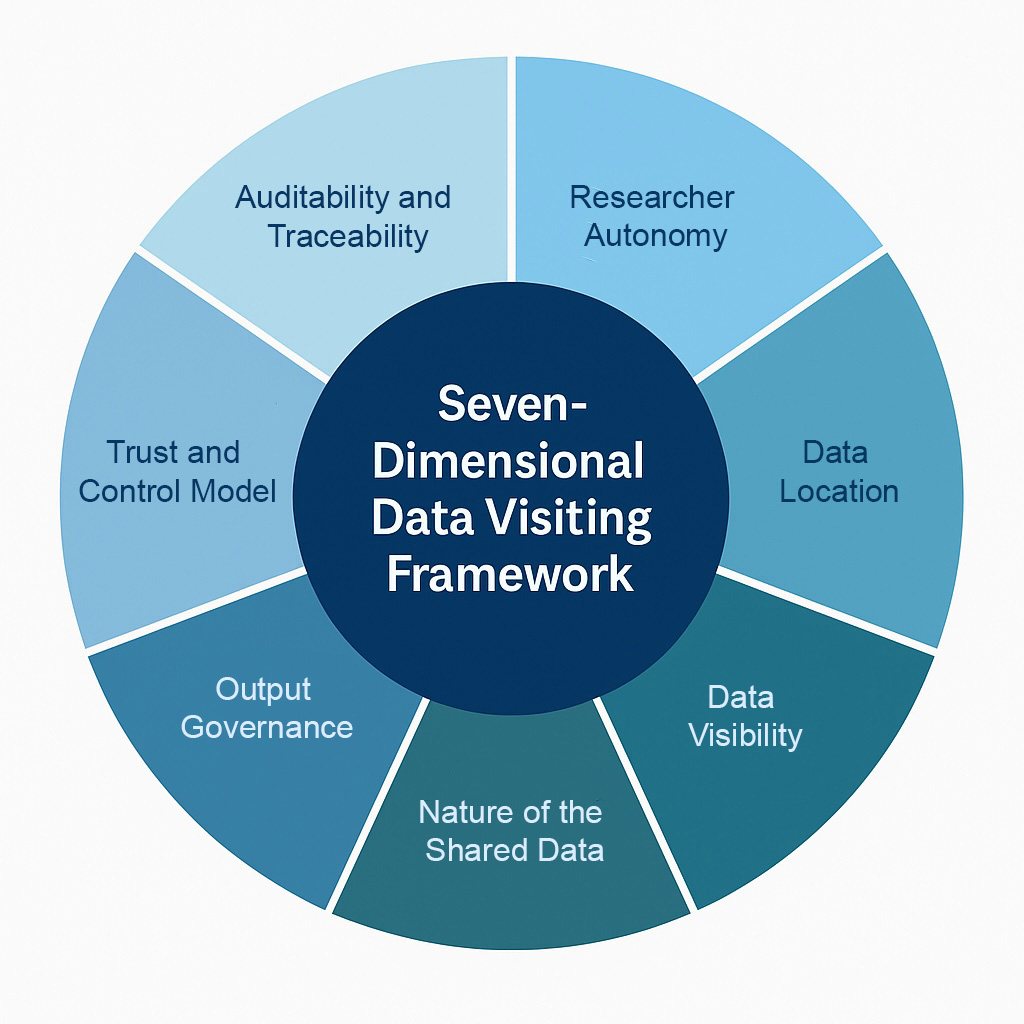
That question motivated the development of the Seven-Dimensional Data Visiting Framework (7D-DVF), which takes the GA4GH lexicon as its starting point and translates it into a practical, configurable governance tool (https://doi.org/10.1186/s40246-025-00864-0). Rather than treating data visiting as a single, monolithic model, the framework disaggregates it into seven adjustable dimensions, each of which functions as a governance lever that can be tuned to fit a specific legal, ethical, and technical context. The framework is descriptive rather than prescriptive: it provides a structured way to describe, compare, and justify governance choices across different data visiting models, rather than telling users which configuration to adopt.
Why a multidimensional approach?
Discussions about data visiting in genomics frequently treat it as a single, coherent model with a fixed set of properties. Even where data visiting is formally defined, it is often spoken about as if it were inherently secure, privacy-preserving, or legally safer, rather than as a practice that can be implemented in many different ways. This tendency to treat data visiting as a unified object obscures the fact that its governance-relevant features are neither uniform nor inevitable.
The 7D-DVF responds to this conceptual compression by disaggregating data visiting into a set of independent, adjustable dimensions. In doing so, it reframes data visiting not as a single solution, but as a configurable space of possible arrangements, in which properties such as security, visibility, autonomy, control, and auditability vary by design. This multidimensional structure makes the complexity of data visiting explicit and usable, turning it into a set of governance levers rather than a monolithic model. Which configurations are permissible or appropriate in any given case will, in turn, be constrained by applicable legal and ethical requirements, which vary by jurisdiction and context.
The seven dimensions as practical levers
The first dimension, researcher autonomy, concerns how much freedom a visiting researcher (or algorithm) has. Can custom code be executed, or are users limited to fixed queries? High autonomy may accelerate discovery but requires stronger compensating safeguards; low autonomy can dramatically reduce risk but may constrain scientific creativity.
Data location asks a deceptively simple question: where does the data physically or virtually reside during analysis? Centralised clouds, institutional servers, and fully decentralised in-situ models all carry different implications for sovereignty, jurisdiction, and control. In many African and Asian contexts, this dimension is decisive for compliance with data localisation laws.
Closely related is data visibility — what the researcher can actually see. Full dataset access, metadata-only views, and query-only interfaces all fall under data visiting, but they support very different risk–utility trade-offs. Query-only visibility, for example, can enable international collaboration even where raw data may never lawfully leave a jurisdiction.
The nature of the shared data makes explicit what is sometimes left vague: are we dealing with identifiable or anonymised data? Each category maps onto different legal obligations and ethical expectations. Treating this as a configurable dimension helps avoid both over-regulation and under-protection.
At the other end of the analytical pipeline lies output governance. What happens to results once an analysis is complete? Are outputs released automatically, reviewed before export, or subjected to privacy-enhancing techniques such as aggregation or noise injection? In many real-world systems, output governance is the last — and most important — line of defence against unintended disclosure.
The trust and control model captures who is in charge. Is governance centralised in a single trusted research environment? Distributed across a federation of peers? Or embedded computationally through technical controls that enforce rules automatically? This dimension is particularly important where historical power imbalances or concerns about data extraction shape institutional and community trust.
Finally, auditability and traceability ask whether actions can be reconstructed and scrutinised. Comprehensive logging, selective monitoring, and embedded provenance metadata all offer different ways of ensuring accountability. In an era of AI-driven analysis, traceability is increasingly central to both legal defensibility and public trust.
From abstraction to application
What makes the 7D-DVF especially useful is that it does not prescribe a single “correct” configuration. Instead, it supports proportionality. A rare disease registry spanning multiple jurisdictions might combine restricted visibility, medium autonomy, strong output governance, and full auditability. A low-risk federated AI training exercise on de-identified data might legitimately relax some of these controls to maximise scalability and efficiency.
This modularity also makes the framework legible to non-technical stakeholders. Ethics committees can use it as a structured checklist. Policymakers can see how legal requirements translate into system design choices. Technical teams gain a shared vocabulary for explaining why a particular architecture looks the way it does.
Why this matters for GA4GH
This work builds on and complements ongoing efforts within GA4GH, including the Data Visiting Study Group, which has played a central role in developing the shared lexicon for data visiting and continues to provide a forum for advancing technical, legal, and governance discussions in this area.
As federated systems, trusted research environments, and AI-driven analytics continue to mature, the central challenge will not be whether data visiting is technically possible, but whether it is governed well. The 7D-DVF provides a structured way to move from reactive compliance to governance-by-design — enabling privacy, sovereignty, and research utility to be balanced deliberately rather than by accident. The framework is intended to support the work of the Data Visiting Study Group and related GA4GH initiatives by offering a shared analytical structure for examining how data visiting can be designed and operationalised across differing legal and ethical contexts.
In this sense, the framework serves as an invitation to design data visiting systems that are transparent, adaptable, and worthy of the trust placed in them.
—
Donrich Thaldar is a Professor of Law at the University of KwaZulu-Natal and a co-chair of the GA4GH Data Visiting Study Group, with research interests in data governance, health law, and genomic research.
—
Further Reading