The first step of any genomic analysis is mapping the new sequence data to a reference sequence — a list of three billion base pairs that have been generally accepted as “normal” for a given population or subgroup. However, standard conventions for naming and identifying reference sequences are lacking. Different organisations refer to the same sequence differently. refget Sequences provides a framework to retrieve reference sequences by using an algorithm to derive a unique identifier. The identifier can then be used to verify the integrity of the reference sequence.
All sequencing-based genomic analysis uses a genomic reference sequence — a baseline of knowledge against which variations are observed. There are multiple human reference sequences of increasing accuracy. For example, two organisations may refer to the same sequence using different names, or reuse names to refer to different reference releases. Reliable, reproducible genomic analysis depends on clear provenance back to reference data. Refget Sequences enables access to reference genomic sequences without ambiguity from different databases and servers using a checksum identifier based on the sequence content itself.
A companion tool to refget Sequences, refget Sequence Collections assigns a name for a collection of reference sequences.
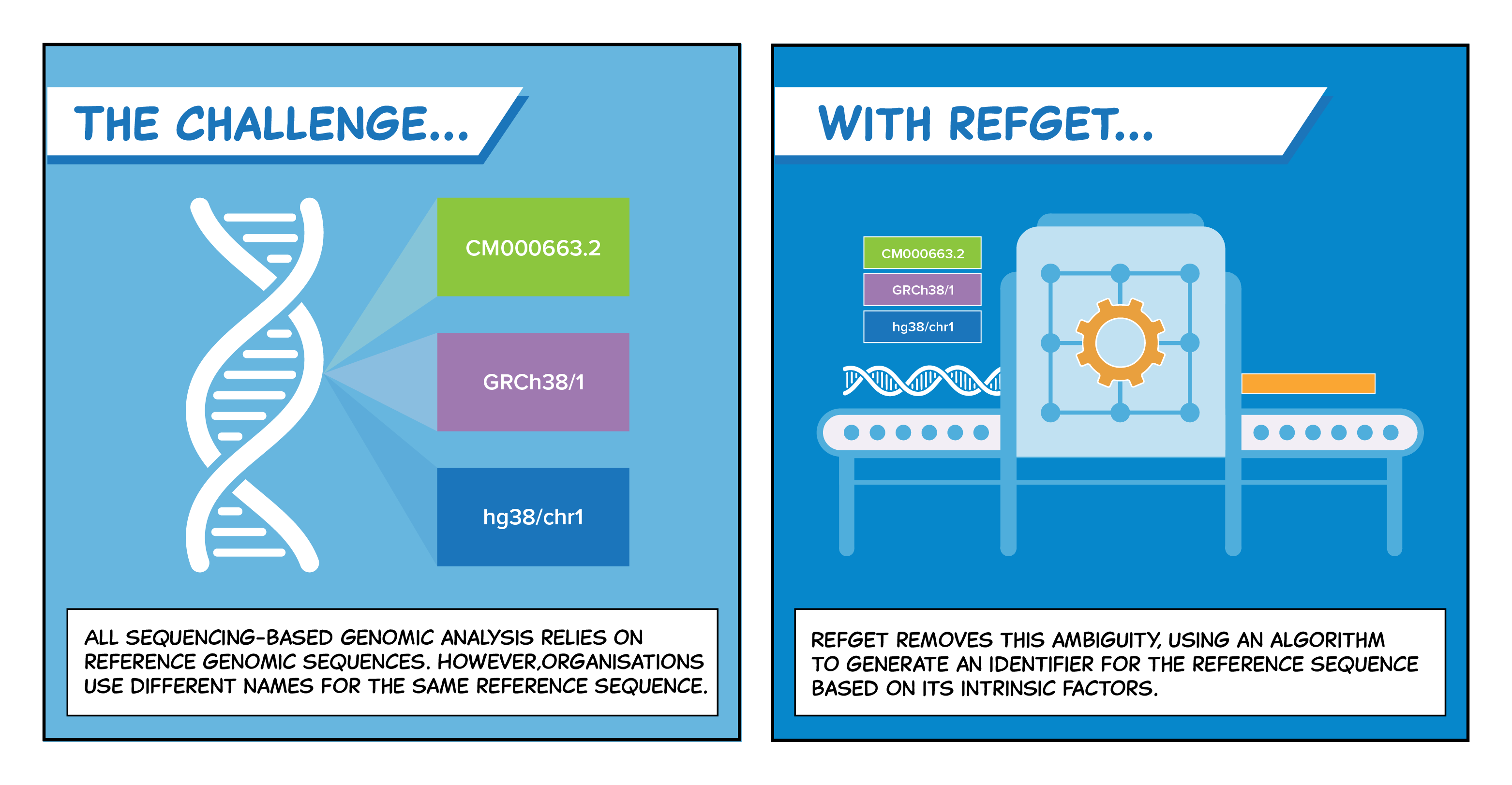
Image summary -
Benefits
- Reliably access reference sequences for genomic studies
- Create unambiguous identifiers for reference sequences
Target users
Researchers
Announcements
| Date | Title |
|---|---|
| 29 February 2024 | Refget: Sequence Collections v1.0 Open for Public Comment |
| 17 July 2023 | refget v2.0 approved |
| 15 February 2023 | GA4GH products open for comment: CRAM v3.1, refget v2.0 |
| Title | Related Driver Projects and Organisations |
|---|---|
| EJP-RD Virtual Platform | European Joint Programme on Rare Disease (EJP RD) |
| ELIXIR-Beacon | ELIXIR Beacon |
| Federated EGA | European Genome-phenome Archive (EGA), EMBL's European Bioinformatics Institute (EBI), Centre for Genomic Regulation |
Publications
| Title | Author(s) | Year |
|---|---|---|
| Refget: standardized access to reference sequences | 2021 |
Documents
| Date | Title |
|---|---|
| 14 September 2023 | Code of Ethics and Community Conduct (CECC) |
| 11 March 2023 | Meeting minutes: Refget |
| 10 March 2023 | Start-up guide: refget |
| 8 December 2020 | Meeting minutes: refget (2021) |
Videos
| Date | Title | |
|---|---|---|
 |
5 December 2018 | Using the GA4GH toolkit: refget API for retrieving reference sequences via checksum |
Contributors
Don't see your name..?
Get in touch- Timothe Cezardrefget Sequences LeadEMBL's European Bioinformatics Institute (EBI), Hinxton, UK
- Nathan Sheffieldrefget Sequences LeadUniversity of Virginia
- Andy Yatesrefget Sequences LeadEMBL's European Bioinformatics Institute (EBI), Hinxton, UK
- Jeremy AdamsOntario Institute for Cancer Research (OICR), Toronto, Canada
- Shakuntala BaichooUniversity of Mauritius
- Robert DaviesWellcome Sanger Institute (WSI), Hinxton, UK
- Sveinung GundersenCentre for Bioinformatics, University of Oslo
- Reece HartMyOme
- Muhammad HaseebEMBL's European Bioinformatics Institute (EBI), Hinxton, UK
- Oliver HofmannUniversity of Melbourne Centre for Cancer Research, Melbourne
- Rasko LeinonenEMBL's European Bioinformatics Institute (EBI), Hinxton, UK
- John MarshallCentre for Population Genomics
- Reggan ThomasEMBL's European Bioinformatics Institute (EBI), Hinxton, UK
Driver Projects
| Title | Thematic Area |
|---|---|
| European Joint Programme on Rare Disease (EJP RD) | Rare Disease |
| ELIXIR Beacon | Rare Disease Cancer Complex Traits Basic Biology |
Version history
| Version | Maintenance | Development | PDAP Review | Date |
|---|---|---|---|---|
| Refget Sequences v2.0 | Maintained | Development | Draft | 17 Jul 2023 |
| Refget Sequences v1.0.1 | Maintained | Development | Draft | 27 Feb 2023 |
| Refget Sequences v1.0 | Maintained | Development | Draft | 9 Mar 2020 |