
Incorporating standard data sharing language into consent forms is beneficial for all parties involved. Participants can have a clear understanding of how their genomic and health data will be used, allowing them to make informed decisions about their personal information. Researchers and governing bodies can clearly understand the data use conditions of any dataset, thus streamlining the data access process.
The Data Use Ontology (DUO) supports this goal by providing standard codes that specify the use conditions of a dataset. To explain how to create consent forms that map directly to DUO, the GA4GH Data Use & Researcher Identities (DURI) Work Stream and Regulatory and Ethics Work Stream (REWS) co-created Machine Readable Consent Guidance (MRCG). The document allows institutions to automate and expedite aspects of the data access process.
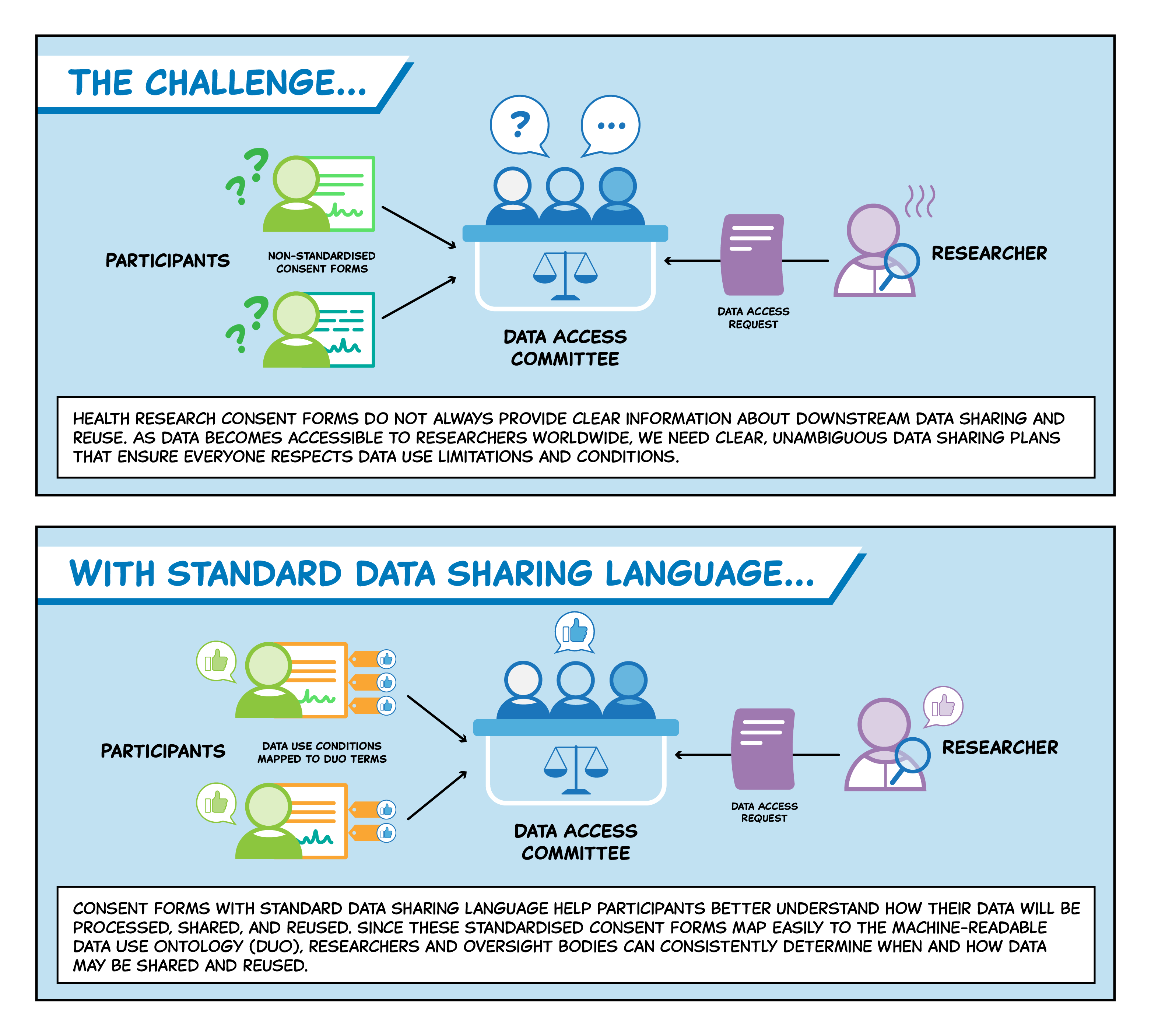
Image summary -
Benefits
- Supports automation of consent collection and tracking
- Supports automation of the data access process
- Provides consent clause summaries and descriptions for each DUO code
Target users
Data generators, data access committees, and data protection authorities
Documents
| Date | Title |
|---|---|
| 14 September 2023 | Code of Ethics and Community Conduct (CECC) |
| 12 January 2023 | Machine-Readable Consent Guidance (v1.0) |
Contributors
Don't see your name..?
Get in touch- Adrian ThorogoodMachine Readable Consent Guidance (MRCG) LeadTerry Fox Research Institute, Vancouver, Canada
- Mélanie CourtotOntario Institute for Cancer Research (OICR), Toronto, Canada
- Clara GaffMelbourne Genomics Health Alliance, Melbourne
- Jaime Guidry AuvilNIH National Cancer Institute (NCI), Bethesda
- Alice MannWellcome Sanger Institute (WSI), Hinxton, UK
- Mizuki MoritaOkayama University
- Tommi NyrönenCSC – IT CENTER FOR SCIENCE
- Soichi OgishimaTohoku University Tohoku, Medical Megabank Organization, Sendai
- Susheel VarmaInformation Commissioner's Office
- Chisato YamasakiNational Institute of Biomedical Innovation, Health and Nutrition (NIBIOHN)


