When a patient has their DNA sequenced, the clinical test shows specific changes in their genes. But when researchers collect knowledge and make statements about genomic evidence, they typically look at categories of variation.
For example, take the phrase “TP53 R248 mutations.” A study on breast cancer might use that phrase to refer to point mutations at location TP53.* The phrase is therefore categorical: it aggregates all variants leading to changes at amino acid position R248 of protein TP53.
The rise of categorical variants presents two problems. First, to interpret whether an assayed variant leads to disease, you need to manually search and collate knowledge spread across multiple categorical variants — a slow, error-prone process. Second, complex relationships between categorical variants frustrate efforts to curate and maintain the knowledge-bases that are crucial for connecting genes and disease.
The Categorical Variation Representation Specification (Cat-VRS) development group tackles these problems by developing a formal, computable specification for categorical variants.
*Berns et al. 1998.
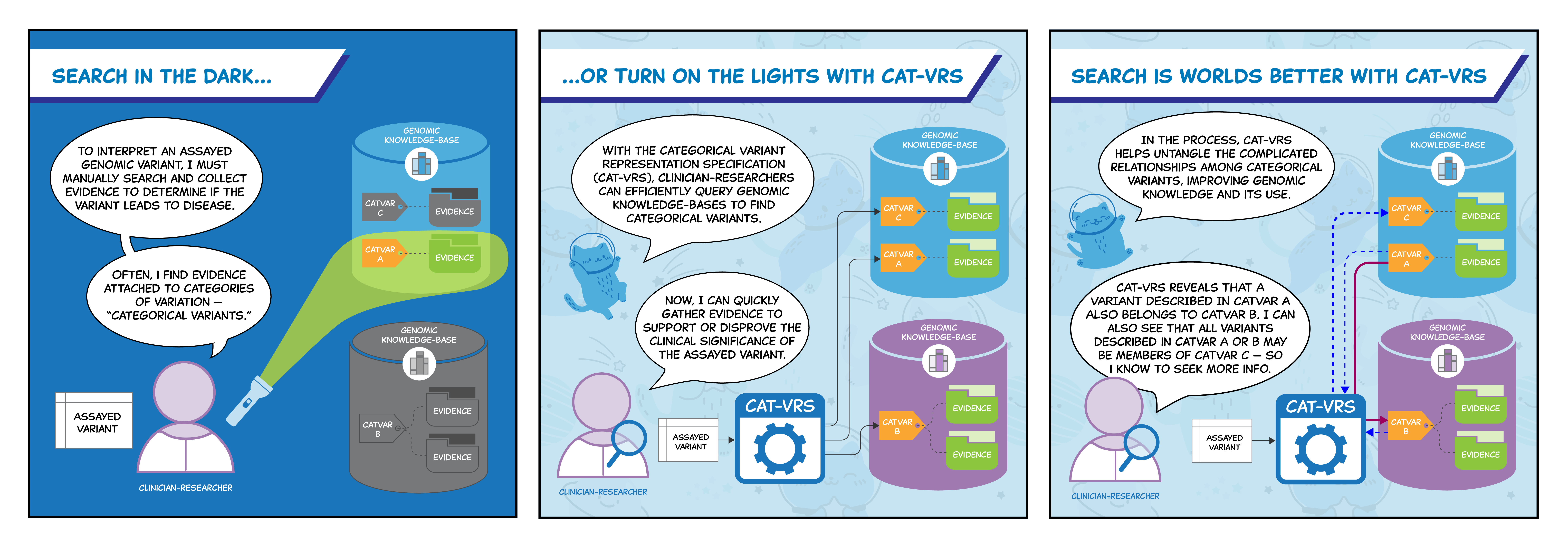
Image summary -
Benefits
- Makes genomic knowledge associated with categorical variants computable and efficiently searchable
- Promotes more efficient and consistent sharing, curation, and availability of genomic knowledge across GA4GH Work Streams and partner organisations
- Ensures effective use of categorical variant knowledge — both now and as genomic knowledge grows in the future
Target users
Researchers, clinicians, clinical laboratories, data generators, data custodians, developers, and research institutes
Announcements
Documents
| Date | Title |
|---|---|
| 16 October 2026 | GKM Meeting Minutes |
| 8 November 2023 | Categorical Variation (CatVar) meeting minutes |
| 14 September 2023 | Code of Ethics and Community Conduct (CECC) |
Videos
| Date | Title | |
|---|---|---|
 |
19 November 2025 | GKS Work Stream Open House (November 2025) |
 |
6 January 2025 | GKS Work Stream Open House (January 2025) |
Contributors
Don't see your name..?
Get in touch- Daniel PuthawalaCategorical Variation Representation Specification (Cat-VRS) LeadNationwide Children’s Hospital, Columbus, OH
- Brendan ReardonCategorical Variation Representation Specification (Cat-VRS) LeadDana-Farber Cancer Institute, Boston
- Larry BabbBroad Institute of MIT and Harvard, Cambridge, US
- Alex WagnerNationwide Children’s Hospital, Columbus, OH, Variant Interpretation for Cancer Consortium (VICC), International