
Genomic features — such as genes, regulatory elements, and repeated sequences, as well as RNA — can have consequences for human health and disease. Developed by the University of California Santa Cruz (UCSC), the Browser Extensible Data (BED) file format is a common method for capturing the location of genomic features and associated annotations. With guidance from UCSC, the GA4GH Large Scale Genomics (LSG) Work Stream has formalised the specification and developed a concrete set of guidelines for using it.
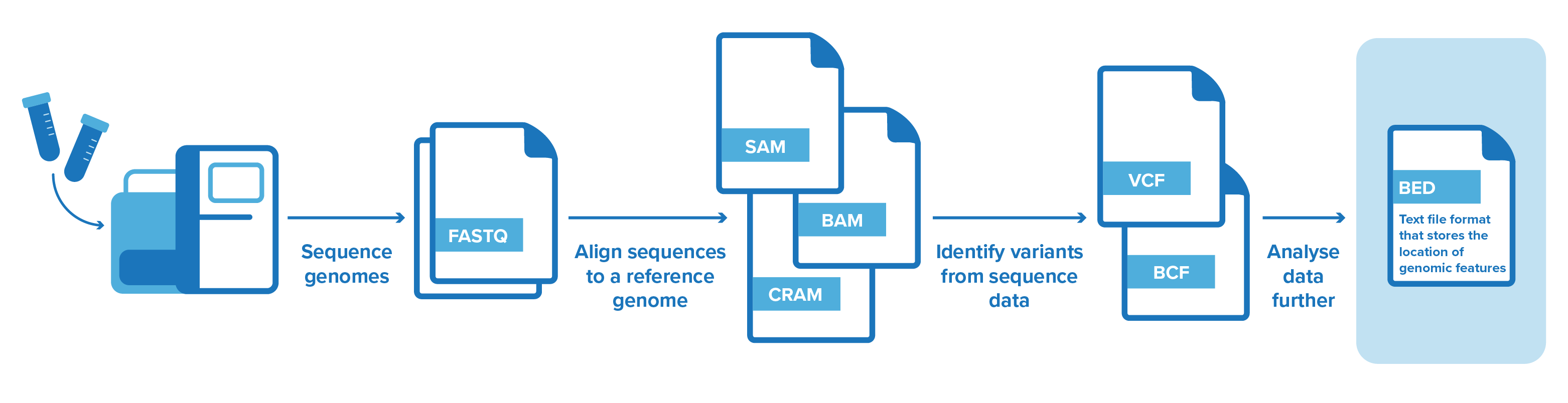
Image summary -
Browser Extensible Data (BED)
Benefits
- Provides a simple and flexible format for describing genomic features
- Outlines concrete guidelines for utilising the format
Target users
Researchers, and clinicians
Documents
| Date | Title |
|---|---|
| 14 September 2023 | Code of Ethics and Community Conduct (CECC) |
| 8 December 2020 | Meeting minutes: File Formats (2021) |
Contributors
Don't see your name..?
Get in touch- Michael HoffmanBrowser Extensible Data (BED) LeadPrincess Margaret Cancer Centre
- Ewan BirneyEuropean Molecular Biology Laboratory (EMBL), Heidelberg, EMBL's European Bioinformatics Institute (EBI), Hinxton, UK
- Yossi FarjounLady Davis Institute
- Oliver HofmannUniversity of Melbourne Centre for Cancer Research, Melbourne
- John MarshallCentre for Population Genomics
- Andy YatesEMBL's European Bioinformatics Institute (EBI), Hinxton, UK
loading...
Powered by Pretty Google Calendar